Your Funnel Works. How Do You Make It Work Better?
Somewhere between the first click and the final sale, you can make every visitor worth more.
Most People Don’t Buy.
And That’s Normal
Every person who reaches your funnel makes a decision.
Some click. Some don’t.
Some opt in. Some leave.
Some open the email. Some ignore it.
Some buy. Most won’t.
But more of them could.
And that’s where the opportunity is.
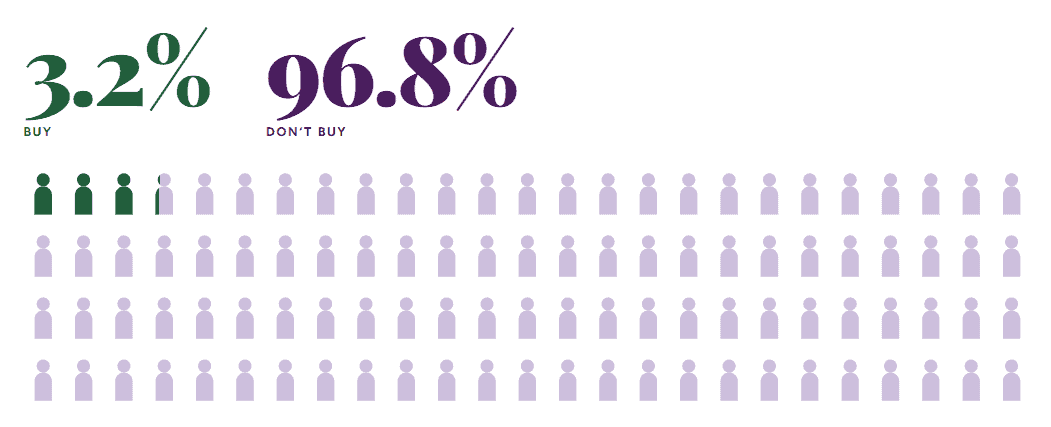
The number tells you what they did.
Your job is to figure out why.
Once a funnel starts making sales, the work changes.
Now you can see what customers actually do at every step between finding your business and buying from you.
And small improvements in that process can make a much bigger difference than they appear to on paper.
Say 1,000 people visit your sales page.
At a 1% conversion rate, you make 10 sales.
Increase that conversion rate to 2% and you make 20 sales.
That's only a one percentage point increase in conversions.
But it's TWICE the sales.
And if the average amount each customer spends stays the same...
That's DOUBLE the revenue from the exact same 1,000 visitors.
No additional traffic required.
That's why the question isn't simply whether your funnel works.
Where could it work better?
Where are people stopping?
Why are they stopping?
And what could you change at that specific point to get more of them to take the next step?
That's what we're going to show you.
ABOUT ME
I Don't Guess Where the Problem Is.
I Look for It.

I'm Jen Perdew, President and CEO of MyNAMS, and I've spent more than 15 years working with online businesses.
Conversions and analytics are two of my specialties.
When something isn't performing the way it should, I want to see the numbers.
They tell me where to start looking.
I recently evaluated a client's email funnel.
Her open rates were over 50%.
That part of the funnel was doing its job.
But almost nobody was clicking.
Now we knew where to focus.
We didn't need to tear apart her entire funnel. We didn't need to chase more subscribers. And we didn't need to waste time changing subject lines to improve an open rate that was already strong.
The problem was what happened after the open.
I changed four of the six emails in her sequence.
Her clicks increased 500%.
That's the power of knowing where to look before you start changing things.
You can stop messing with the parts that are already doing their job and focus your attention on the conversion point that isn't.
And that's exactly what I'm going to teach you to do inside Fix Your Conversions.
The Final Sale Only Tells You How the Story Ended
Most business owners know their final numbers: how many people joined the list, how many sales came in, and how much money the promotion made.
Those numbers are important, but they don’t tell you what happened along the way.
Before someone becomes a customer, they make a series of smaller decisions. They decide whether to click, opt in, open an email, click again, consider the offer, start checkout, and complete the purchase.
Every one of those decisions is a conversion point.
And every conversion point is another place where the performance of your funnel can improve.

When you only look at the final sales number, you know how the story ended. You don’t know which part of the story changed the outcome.
Maybe more people need to click. Maybe they’re clicking but not opting in. Your emails might be getting opened while almost nobody moves to the offer. Or the sales page could be doing its job while buyers disappear during checkout.
Those are different conversion problems, and they require different fixes.
Changing the sales page won’t solve an email click problem. Rewriting your emails won’t fix a checkout problem. Sending more traffic to a weak opt-in page simply sends more people to the same conversion point.
Your goal isn’t to improve everything. It’s to find the conversion point worth your attention, understand what’s happening there, and make the change most likely to improve it.
The Most Expensive Fix Might Be the One You Never Needed
When sales aren’t where you want them, it’s easy to start changing things.
Rewrite the sales page. Change the offer. Add a bonus. Send more emails. Lower the price. Buy more traffic.
Any one of those changes could improve your results.
Or you could spend days working on something that was already performing exactly as it should.
That’s the problem with making changes before you know which conversion point needs your attention.
Think back to my client with the 50%+ email open rate.
She came to me ready to throw out the offer.
“This offer doesn’t work.
I’m not making sales.”
But when we started at the beginning of the funnel, the numbers told us where to look.
Her paid traffic was hitting an opt-in page converting at 40%.
Then those new subscribers were opening her emails at a rate of more than 50%.
We had no reason to start tearing apart either of those conversion points.
Then we looked at what happened next.
People weren’t clicking the links in the emails.
And if they weren’t clicking, they weren’t reaching the sales page.
So how could we decide the offer didn’t work when most of those prospects weren’t getting far enough into the funnel to see it?
She was about to fix a problem we hadn’t even proven she had.
The numbers pointed us somewhere else.
Her email clicks were the conversion point that needed our attention.
Sales told us something was wrong.
The conversion points told us where.
Your funnel isn’t one big conversion rate. It’s a series of conversion rates connected to each other.
A strong conversion at one point can lead directly into a weak conversion at the next.

Once you know which point needs attention, you can ask a much better question.
Instead of:
“Why isn’t this offer making sales?”
You can ask:
“Why are people opening my emails but not clicking?”
Or:
“Why are people reaching checkout but not completing their purchase?”
Or:
Now you have a specific problem to solve.
And you can put your time, money, and attention into fixing the problem you found instead of the one you assumed you had.
“Why are visitors seeing my opt-in page but not subscribing?”
Your Spreadsheet
Doesn’t Need to Become
Your New Best Friend.
You didn’t start your business to look at numbers all day.
I bet you don’t love spreadsheets, percentages, and analytics dashboards.
Most of my clients don’t. They’d much rather create something, work with their customers, write an email, teach, or come up with their next offer.
I get it.
I happen to love this stuff.
Give me the numbers, and I want to figure out what they’re telling us.
But you don’t have to feel the same way I do.
You can pay someone to track your numbers. You can have a team member pull the reports. You can use software to collect the information.
What you can’t do as the business owner is ignore what those numbers are telling you.
Every time you decide what to change, where to spend money, what to promote, or what deserves your time, you’re making a business decision.
The numbers give you information to make that decision.
You don’t have
to love the numbers. You just need to know what they’re telling you.
Then you can decide what deserves
your time, attention, and money.
I’m not going to try to turn you into someone who gets excited about a conversion report.
That can stay my thing.
I’m going to show you how to find the numbers that matter, understand what they’re telling you, and use that information to make better decisions about your funnel.
Then you can get back to the parts of your business you’d much rather be doing.
Don’t Become
a Conversion Expert.
Become a Mind Reader.
Okay, not literally.
But this is about as close as we can get.
Every number in your funnel represents something a person did.
They clicked. They stayed. They
left. They opened. They ignored.
They bought. They didn’t.
Those numbers aren’t sitting in your analytics to give you more homework.
They’re your customers talking to you through their behavior.
They’re showing you where they’re interested, where they keep moving, where they hesitate, and where they decide they’ve had enough.
And once you start looking at conversion data that way, percentages become a whole lot more interesting.
You’re looking at a group of people who were presented with a choice and asking:
“What made some of them say yes
while the others walked away?”
That’s where conversion work gets interesting.
The number tells you what they did.
Your job is to figure out why.
The Numbers Can Show You Where Your Next Sales Are Hiding
Let’s put some numbers to this.
You want more sales.
Where do you start?
Well... it depends on what your customers are already doing.
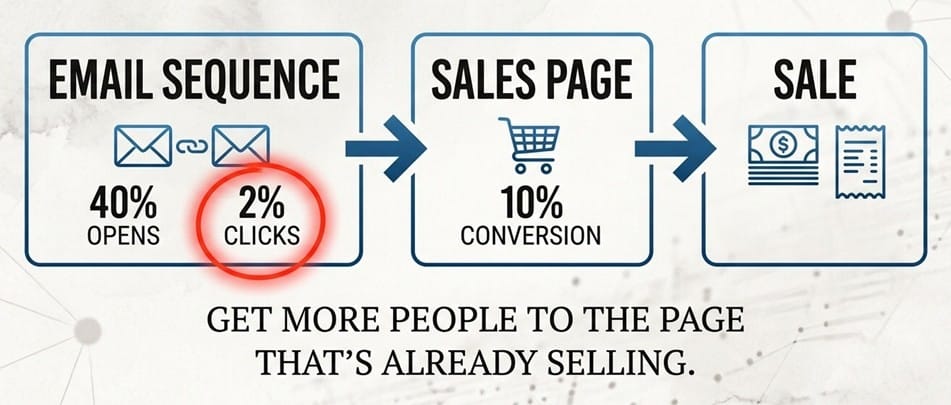
SCENARIO 1: YOUR SALES PAGE IS ALREADY WORKING
Your sales page converts at 10%.
Great.
But then you look at your evergreen email sequence.
40% opens.
2% clicks.
There’s no reason to start messing with a sales page that’s converting at 10% when so few of your email readers are getting there.
Get more of those readers to click, and more people land on the page that’s already making sales.
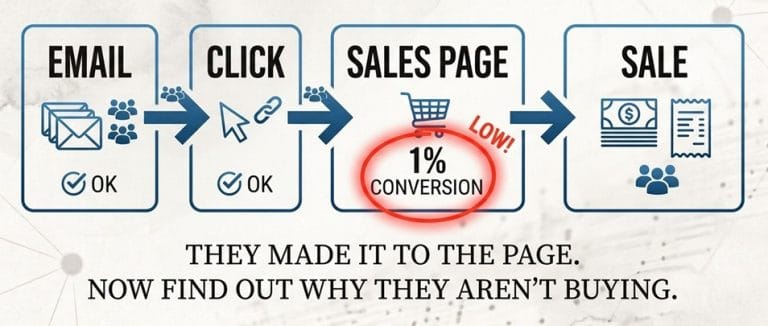
SCENARIO 2: PEOPLE ARE GETTING THERE. THEY JUST AREN’T BUYING.
Now flip it.
Your emails are getting opened.
People are clicking.
Traffic is reaching your sales page.
But the page is converting at 1%.
Now I’m looking at the sales page.
What are people seeing when they get there?
Does the message match what got them to click?
Does the offer give them enough reason to buy?
Are they hesitating somewhere?
This time, sending more traffic doesn’t answer the question.
The people are already there.
Now we need to figure out why more of them aren’t saying yes.
SCENARIO 3: THEY’RE ALREADY BUYING
Here’s one of my favorites.
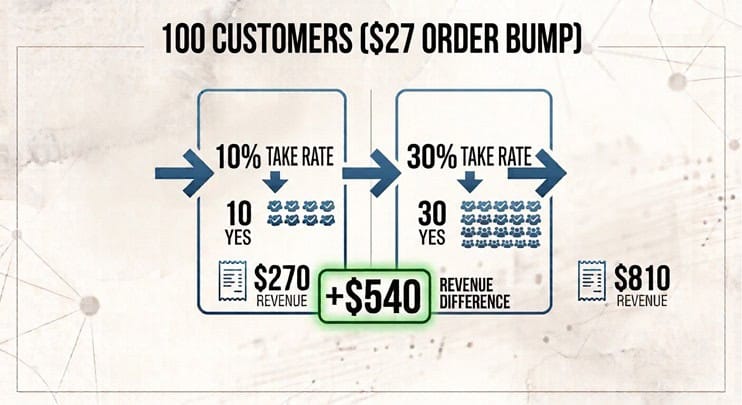
You have a $27 order bump at checkout.
100 people buy your main offer.
If 10% add the bump, that’s another $270.
But I like to see order bumps converting around 30%.
Get that same $27 bump to a 30% take rate and those same 100 customers generate another $810.
That’s $540 more.
No additional traffic.
No additional customers.
Just more of the people who were already buying saying yes to the bump.
That’s why “I need more sales” isn’t enough information.
Meet Fix Your Conversions
Fix Your Conversions is my step-by-step process for business owners who already have a funnel, traffic, subscribers, customers, or sales and want to get more from what they’ve already built.
I’m going to show you how I look at a funnel when I’m trying to figure out what’s happening inside it.
What numbers do I look at?
What do those numbers tell me about customer behavior?
Where would I focus first?
And once I find the conversion point I want to improve, what would I look at next?
You don’t need another funnel.
You need to know what the one you already have is telling you.
You Don’t Need All the Answers. You Need a MAP.
There are some things about conversions you need to know.
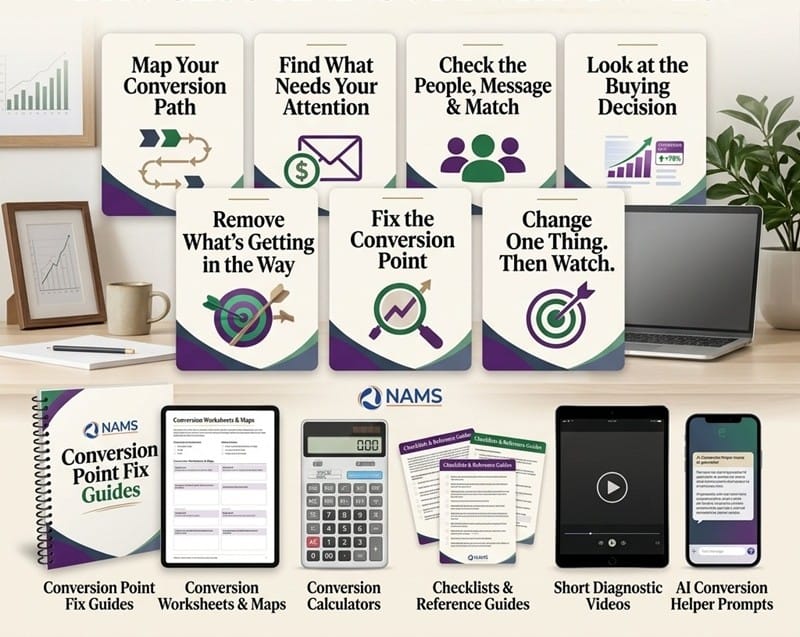
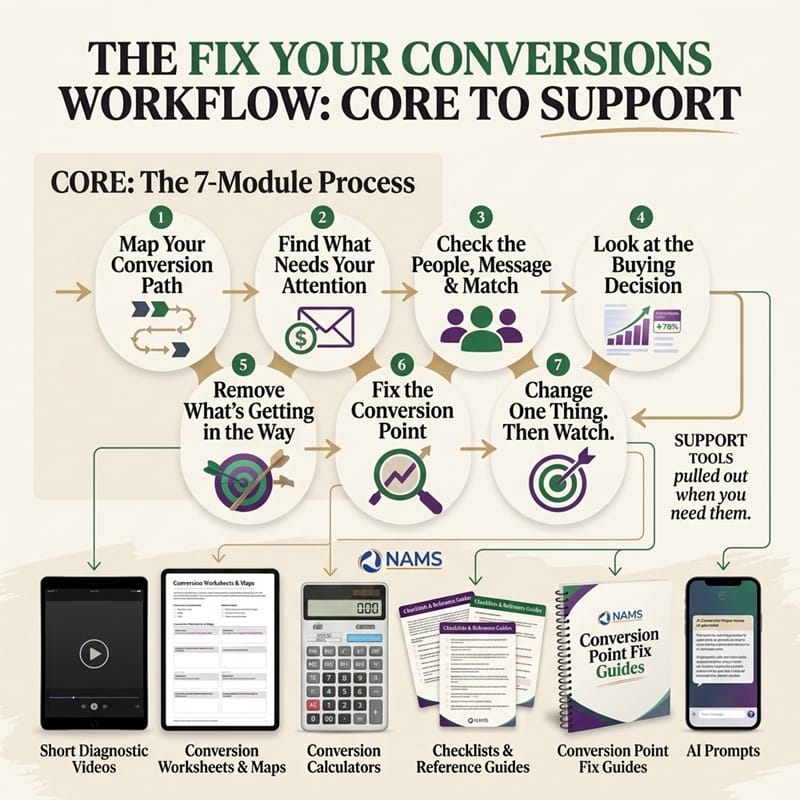
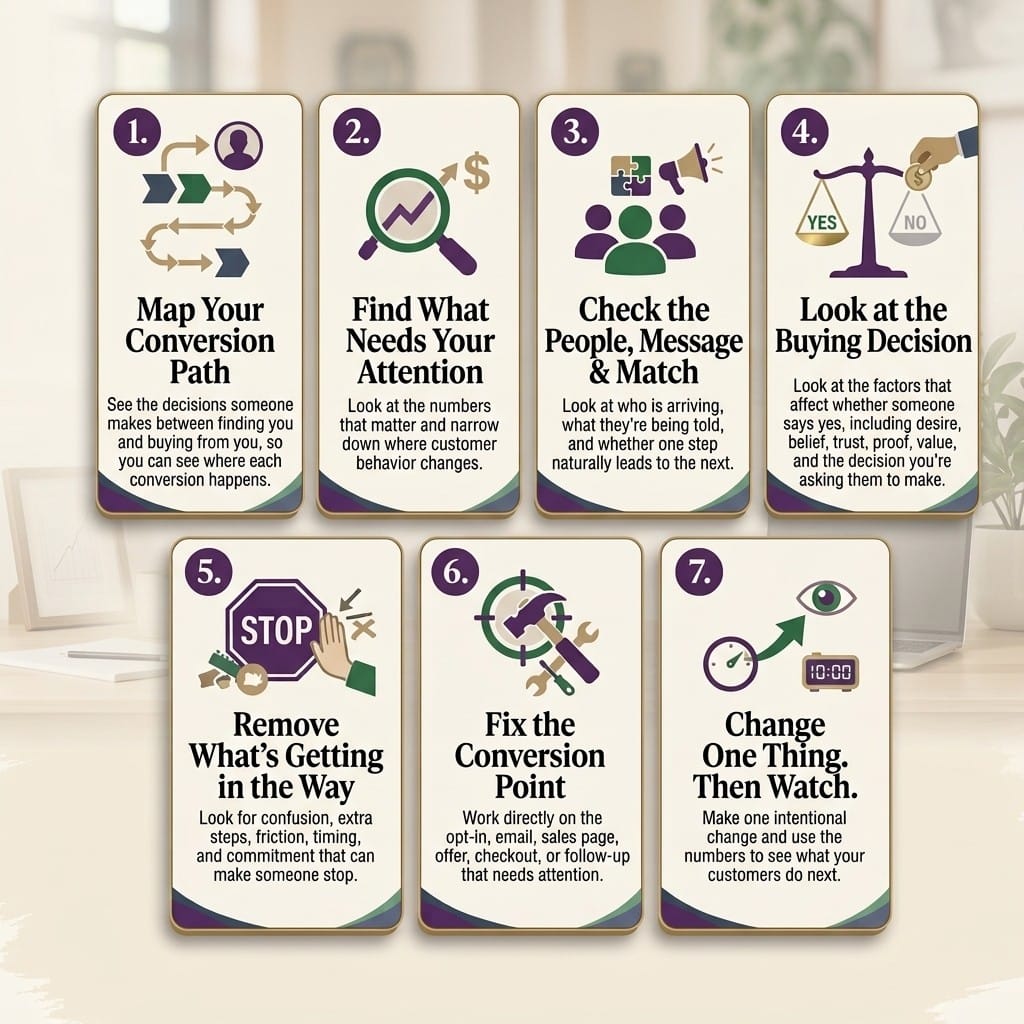
That’s what the 7 core modules give you.
They give you the foundation to look at your funnel, understand what your customers are doing, and know where to focus your attention.
Then, when you’re working on a specific conversion point, the support is right there.
If your emails aren't getting clicks, go there.
If people are reaching your sales page but aren't buying, go there.
If your checkout or order bump isn't converting the way you want, go there.
The supporting videos are short and specific. Pull up the conversion point you’re working on, see what I look at, and use the tools that go with it.
And six months from now, when something else isn't converting?
Pull it back out.
The Tools You Pull Out When You Need Them
You’re not supposed to memorize everything.
The support materials are there to help you apply the process when you’re staring at a specific conversion problem.
You’ll have:
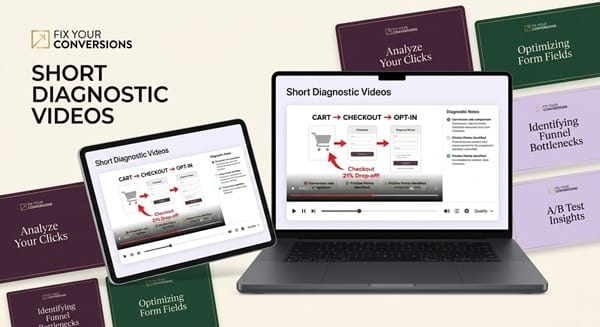
Short Diagnostic Videos
Go directly to the conversion point you're working on and see what I look at and what I check.
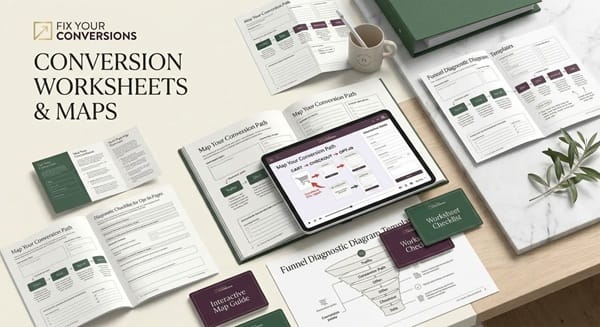
Conversion Worksheets & Maps
Work through your funnel and customer path without trying to keep everything straight in your head.
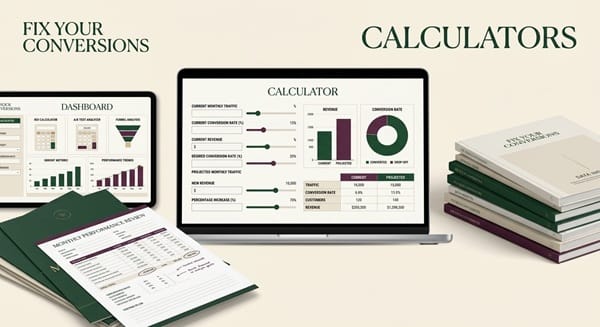
Calculators
Do the math without turning this into a spreadsheet project.
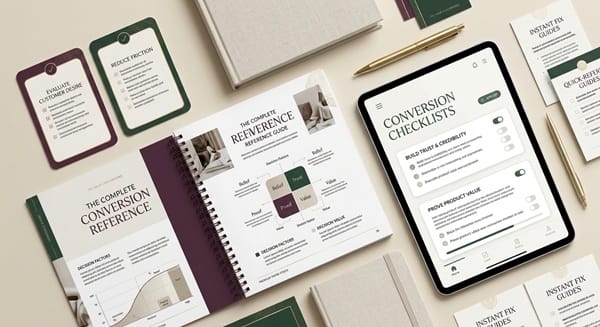
Checklists & Reference Guides
Quickly check the factors that could be affecting the decision your customer is making.
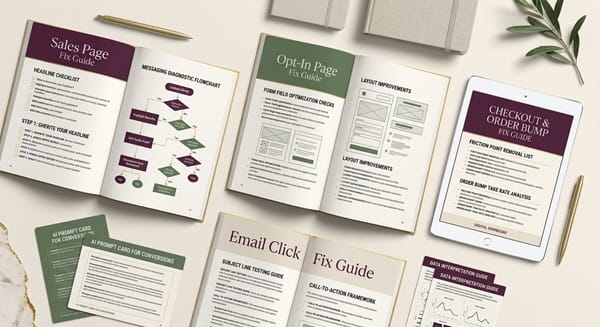
Conversion Point Fix Guides
Pull up the guide for the specific part of your funnel you’re working on.
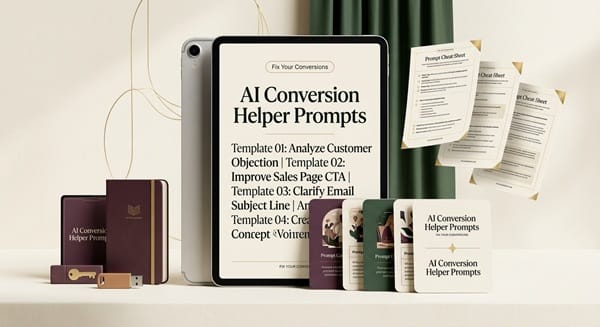
AI Conversion Helper Prompts
Bring AI into the process when you want help examining what you’re seeing or working through a possible fix.
Your Funnel Was Never
Supposed to Be Perfect.
You built it with the best information you had.
You made decisions about the offer, the page, the emails, the checkout, and the follow-up.
Then you put it in front of real people.
And they did what real people do.
Some clicked. Some didn't.
Some bought. Some didn't.
Some did exactly what you expected.
Others surprised you.
That doesn't mean you built a bad funnel.
It means you finally have something you didn't have when you built it:
Real customer behavior.
Now you have something to work with.
The problem is what usually happens next.
When the sales aren't where we want them, we decide we need...
MORE.
More traffic.
More emails.
More content.
More bonuses.
More promotions.
More products.
Maybe a whole new funnel.
But if there's already a place in your funnel where people are dropping out...
you're just sending MORE through the same problem.
You're working harder.
You're creating more.
You're spending more.
And you're still wondering why the sales aren't following.
THAT'S SWIMMING UPHILL.
Before you create one more thing, look at what you've already created.
You already have traffic coming in.
You already have people on your list.
You already have emails being opened.
You already have offers people are seeing.
You already have customers buying.
You've spent time, money, and energy building those assets.
So maybe the first question isn't:
“What else do I need?”
Maybe it's:
“What could I get more from?”
That's what Fix Your Conversions gives you a way to answer.
Not so you can spend your days staring at analytics.
And not so conversion optimization becomes another job you've created for yourself.
So you can find what deserves your attention, work on that, and get back to creating, selling, teaching, serving your customers, and running the business you actually wanted to build.
What could I get more from?
Everything You Need to Find It. Fix It. Watch What Happens.
Fix Your Conversions gives you the process to find exactly where you're losing sales, leads, clicks, and the traffic you've already worked to get, and what to fix first.
And the tools to fix it once you find it.
CORE: The Fix Your Conversions Process
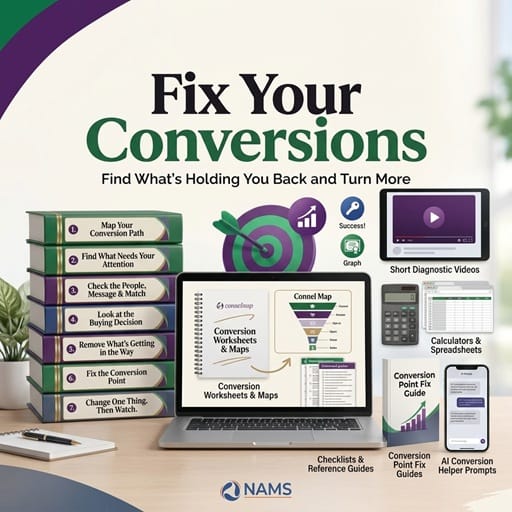
Your 7-module process for looking at your funnel, reading what your customers are doing, finding where sales, leads, clicks, and traffic are being lost, and knowing what to work on next.
This is the part you start with.
It gives you the foundation you'll use every time you come back to Fix Your Conversions.
The Tools You Pull Out When You Need Them
Once you know where you want to focus, you don't have to figure out the rest from scratch.
You'll also get:
Short Diagnostic Videos
Go directly to the conversion point you're working on and see what I look at and what I check.
Conversion Worksheets & Maps
Work through your funnel and customer path without trying to keep everything straight in your head.
Calculators
Run the numbers without building another spreadsheet.
Checklists & Reference Guides
Check the factors that could be affecting the decision your customer is making.
Conversion Point Fix Guides
Go directly to the part of your funnel you're working on.
AI Conversion Helper Prompts
Use AI to help examine what you're seeing, think through possible causes, and work through your next change.
You don't need to use all of it today.
Start with CORE.
Then keep the rest nearby.
When your emails aren't getting clicks, pull out what you need.
When a sales page isn't converting the way you expected, come back.
When an order bump isn't getting enough yeses, come back.
When a funnel that used to work suddenly isn't performing the same way, come back.
Fix Your Conversions isn't something you use once and put on a digital shelf.
It's something you come back to whenever the numbers tell you it's time to take another look.
The Expensive Part of Not Knowing What's Wrong Is That Everything Becomes a Candidate for Your Time and Money.
When sales aren't where you want them, uncertainty gets expensive fast.
Because if you don't know what's causing the problem, almost any change can sound reasonable. And once you start making those changes based on a hunch, you can put hours of work and real money into fixing something that wasn't broken in the first place.
That's the part we don't talk about enough.
There's value in finding the problem. There's also value in ruling things out.
When the numbers tell you something is working, you get to leave it alone.
You don't rebuild it because sales were down this week. You don't start changing it because the last promotion disappointed you. And you don't spend money trying to improve it simply because you don't know where else to look.
You can protect the parts of your business that are already doing their job and put your time and money into the part that isn't.
Knowing what NOT to fix can be just as valuable as knowing what to fix.
Get Fix Your Conversions
Find where you're losing sales, leads, clicks, and the traffic you've already worked to get. Know what to fix first. And stop spending your time and money fixing things that are already working.
Immediate access to the complete Fix Your Conversions process and all supporting tools.
You have absolutely NOTHING to lose!
Our 7 Day Money Back Guarantee means the risk is 100% mine not yours.
If you’re familiar with our organization, you know that we always provide our customers with 110%.
If you’re not, know that we always provide extra value to ALL our customers. That being said:
Not sure this is right for you?
What if we told you that there’s no risk to you whatsoever? That’s right! With our 100% Money- Back, No-Questions- Asked Guarantee, you have ZERO RISK!
If you purchase this product today, and are not 100% satisfied within 7 days of purchase, you'll receive a full refund. No questions asked. Just submit a support request in the Support Desk and we'll refund your purchase price immediately.

Questions?
Let's Answer Them.
Start with the 7 core modules. That's where you'll learn the process you'll use every time you look at a funnel.
The remaining videos are short, specific support. You don't watch them all. You go to the one you need when you need it.
Absolutely. Businesses hire me to do exactly this.
I charge $200 an hour because diagnosing where a funnel is losing conversions is a specialized skill.
Fix Your Conversions gives you the process I use, whether you make the changes yourself or hand them off to someone else.
AI can give you a very good answer to the wrong question.
If you hand it your sales-page numbers when the real problem is happening before people ever reach the page, you're looking in the wrong place.
Fix Your Conversions helps you find the question worth asking. Then AI can help you work on the answer.
You don't need thousands of visitors to start paying attention to customer behavior.
Sometimes you'll have enough information to act. Sometimes the numbers will tell you that you need to wait for more data.
Knowing when NOT to make a change is part of the process too.
Not very.
I give you the spreadsheet with the formulas already built in. You add your numbers, and it does the math for you.
Your job isn't to become a data analyst. It's to understand what those numbers are telling you and know where to look next.
If your funnel is converting well and needs more qualified people coming into it, yes.
But if you're already losing people at a conversion point, more traffic sends more people into the same problem.
The numbers tell you which problem you have.
Then we want to know that.
Fix Your Conversions isn't designed to prove that everything you've built is working. It's designed to find the point that isn't.
If that's the offer, that's where your attention goes.
No.
You'll learn the conversion numbers you need, but Fix Your Conversions is built around a different question:
Because there's no point split-testing a sales page when the sales page isn't the problem.
Your Funnel Is Working. Now Make It More Profitable.
You don't need every conversion point to be perfect.
You need to find the places where you're leaving money on the table and fix the ones that can put more of it back into your business.
That's what Fix Your Conversions is built to help you do.
Find What's Costing You Money. Fix It. Make More From What You Already Have.
About NAMS
The Novice to Advanced Marketing System is a step-by-step system focusing on Team, Training and Tools to help novice to advanced business people build a Simple, Scalable and Sustainable business.
Founded by David Perdew over 15 years ago, he recently retired and his daughter, Jen Perdew, who has been working at NAMS since 2011 purchased the business.
Jen is now the President and CEO of NAMS and comes from a customer service, operations, and employee training background.
Jen has always loved digging in and getting her hands dirty with automation and coaching. Jen's an implementor and focuses on moving her clients as quickly as possible down the path to success. and has since taken over most of the technical training in the business. NAMS is one of the most successful online communities today, specializing in training and proprietary productivity software tools.